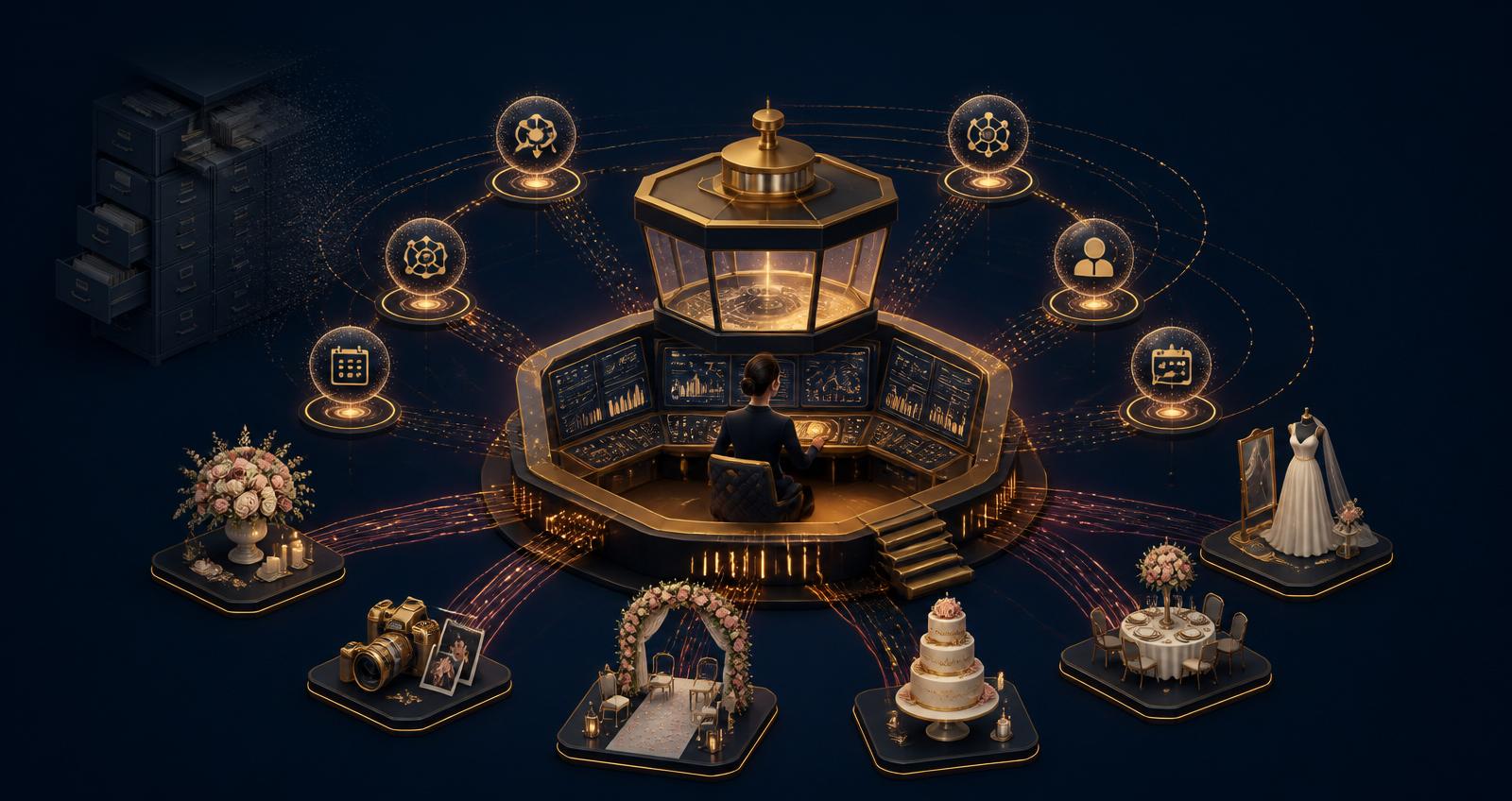
The global wedding industry has always been recession-resistant, emotionally driven, and structurally fragmented. What it has not been, until recently, is technically interesting. That is changing. The convergence of AI-native search, outcome-based SaaS pricing, geographic content locking, and a generational handoff to Gen Z buyers is producing the first genuinely differentiated technology layer the industry has seen since The Knot went online in 1996. For investors, platform operators, and vendors paying attention, the structural winners are becoming legible.
This is Issue 001 of the WeddingSaaS.com Financial and Industry Intelligence series — a standing brief on where money is moving, which platforms are architecturally positioned to win, and what the technology signals mean for vendors on the ground. Three numbers frame it: a $100B US wedding market in 2025, 36% of couples now using AI in planning, and Gen Z at 41% of the market.1
01 — The Market Signal Nobody Is Pricing In
The Knot Worldwide's 2026 Real Weddings Study — the largest of its kind at over 10,000 surveyed couples — confirmed what anecdotal data had been pointing to for two years: AI adoption among engaged couples nearly doubled year-over-year, reaching 36%. The study also confirmed that couples use AI primarily for early-stage discovery and inspiration, then move to trusted platforms to validate and transact.1
This is the critical structural insight. AI does not close the sale — it opens the funnel. The platform that appears in that AI response is the platform that captures the lead. This dynamic, called Answer Engine Optimization (AEO), is the single most important distribution shift in consumer-facing SaaS since mobile search overtook desktop. Platforms that have spent the last decade building domain authority through structured, city-specific, semantically rich content are now sitting on infrastructure that AI models pull from directly. Platforms that have not are invisible at the top of the funnel.
"Couples use AI for functional tasks and creative inspiration. While AI helps spark ideas, couples continue to rely on trusted wedding planning platforms to validate details and make final decisions." — The Knot Worldwide 2026 Real Weddings Study.
The implication for platform operators is direct: authority at the city and category level — not at the brand level — is what gets surfaced. A platform that has published 5,800-word structured guides for wedding vendors in Surrey, BC and Langley, BC and Richmond, BC is answering the questions AI models are being asked. A platform with a single national landing page is not.
02 — GEO: The Structural Moat That Compounds
Geographic Engine Optimization (GEO) is distinct from traditional local SEO. Where local SEO targets keyword rankings, GEO targets the geographic indexing logic of AI models — building content that establishes a platform as the definitive authority for a specific category in a specific city. The distinction matters because AI models do not return ranked lists the way search engines do. They return single answers. First position in an AI response is total capture; second position does not exist.
Platforms that have systematically built city-level content — verified vendor directories, local bylaws and permit guides, pricing benchmarks by neighbourhood, cultural wedding traditions by community — have built a compounding moat. Each piece of city-specific content is a node that reinforces the platform's authority for that geographic entity in AI training and retrieval. This is infrastructure that takes years to build and cannot be replicated quickly by a funded competitor arriving late.
Intelligence note, GEO architecture: a platform with 800+ city pages, each containing structured vendor data, cultural content, local pricing context, and FAQ schema markup, becomes the entity AI models associate with wedding planning in those geographies. When a user asks an AI assistant who the best wedding photographers in Burnaby, BC are, the model does not search Google. It draws on the entity relationships built into its training and retrieval layer. The platform that owns that entity relationship wins the lead before the user ever types into a search bar.
This is not theoretical. It is the structural logic behind why root domains with 10+ year authority records are now the most defensible assets in consumer SaaS. The domain is the entity. The content is the proof.
03 — Outcome-Based Pricing: The Model the Rest of the Industry Is Being Pushed Toward
The most structurally interesting pricing development in wedding SaaS has nothing to do with subscription tiers or freemium conversion rates. It is the emergence of outcome-based, city-locked pricing that scales with the economic reality of the market being served — what practitioners call purchasing power parity (PPP) pricing.
The model works like this: vendors pay a flat monthly rate, set by the population and economic output of their city, for exclusive category territory in that market. One photographer per city. One caterer per city. One florist per city. The pricing floor is $10 per month in smaller markets; it scales proportionally in larger ones. The vendor is not buying an ad impression or a directory listing. They are buying the only position available in a given geography.
This is not new in theory — exclusive territory models have existed in franchise law for decades. What is new is the digital execution at scale, and the intersection with AEO and GEO infrastructure. When the platform that holds the city territory also owns the AI search real estate for that city, the vendor's $10/month is not a marketing spend. It is a structural position in the only channel that matters at the top of the funnel.
Deloitte and McKinsey have both published analysis in the past 18 months indicating that outcome-based and usage-based pricing is the trajectory of enterprise SaaS over the next five years.23 The wedding vendor market — dominated by small operators with thin margins and high customer acquisition costs — reached that conclusion independently, faster, and by necessity rather than by design.
04 — The Competitive Landscape: Where the Structural Gaps Are
The incumbent platforms — The Knot Worldwide (operating The Knot, WeddingWire, and eight international brands), Zola, and a cohort of AI-native challengers including Wedd.ai — each have structural advantages and structural blind spots that are now becoming consequential.
The Knot Worldwide: 30-year domain authority, 15M monthly visitors, and a ChatGPT integration shipped in January 2026. Structural gap: Western-market bias, a vendor ad model under pressure, and thin multicultural coverage. AEO position: strong, as first mover inside an AI assistant.
Zola: registry commerce, design-forward UX, strong registry monetisation. Structural gap: no vendor marketplace depth, no city-level content, and a product tuned to small and medium Western weddings. AEO position: weak — content-thin for AI retrieval.
Wedd.ai: AI-native features including face-recognition galleries and WhatsApp RSVP, with an India market focus. Structural gap: social layer only, no logistics infrastructure, weak domain authority. AEO position: weak — thin domain, no geographic content.
Weddings.io: root domain authority since 2015, 800+ city pages, PPP pricing model, and multicultural architecture spanning Chinese, Persian, Jewish, South Asian and Western traditions. Structural gap: platform migration and infrastructure build still in progress, plus brand dispute noise in Ontario. AEO position: strong — city-level entity authority and structured content depth.
The competitive picture that emerges is one where the incumbents own the legacy funnel — brand recognition, broad vendor inventory, existing booking relationships — while the structural opportunity in AEO and GEO city-locking remains largely uncaptured at the city and culture level. The platform that closes that gap first, at scale, across the highest-population North American markets, is building the most defensible position available in the sector right now.
05 — The Gen Z Variable: Why Cultural Architecture Matters More Than Design
Gen Z now represents 41% of the wedding market by survey, a figure that will only grow. Their influence on product requirements is measurable and specific. They are not simply younger millennials with different taste in fonts. They are buyers who have grown up with cultural specificity as a baseline expectation — not a premium feature. The Knot's 2026 study found that 32% of couples now incorporate religious, ethnic, or cultural elements in their wedding. Among Gen Z couples, that figure is substantially higher.1
Platforms built around a single cultural template — the Western white-dress registry model — are structurally underserving this market. Platforms with distinct architectural tracks for Chinese tea ceremonies, Persian Sofreh Aghd, South Asian multi-day celebrations, Jewish Kabbalat Panim, and Western ceremonies are not simply offering content variety. They are offering different vendor networks, different venue categories, different catering requirements, different timeline structures, and different family-side logistics. The platform that can serve all of these at the city level — with verified local vendors for each tradition — is building something The Knot's current architecture cannot replicate without a rebuild.
"Traditional, cookie-cutter weddings are giving way to celebrations centred on authenticity, intention, and personal expression. Gen Z's influence is unmistakable." — The Knot Worldwide 2026 Real Weddings Study.
06 — What to Watch in the Next 12 Months
Several dynamics will clarify the competitive picture over the next year. The Knot's ChatGPT integration is a significant move — the first wedding platform embedded directly in an AI assistant at scale — but it is a distribution move, not an authority move. Distribution without city-level content depth produces generic answers. The question is whether they can execute city-level content at the speed required to match the platforms that have been building it for a decade.
On the pricing side, the outcome-based city-locking model will face its first real test as platform operators scale into mid-tier markets — cities of 50,000 to 200,000 population where vendor concentration is lower and territory value is less immediately obvious. How vendors in those markets are educated and converted will determine whether the model scales below Tier 1 cities or remains a major-metro play.
The multicultural architecture story will become central to funding conversations. Any wedding platform approaching a Series A or growth round in 2026 or 2027 will face questions about South Asian and East Asian market penetration — the two fastest-growing wedding demographics in North America by spending. Platforms without credible infrastructure in those segments will struggle to answer.
Finally, the brand integrity story matters more than it has in previous cycles. Trademark disputes, passing-off cases, and platform impersonation in the wedding SaaS space are no longer edge cases. With domain authority being the primary asset in an AEO world, the entity that controls the root domain controls the answer. Disputes over who legitimately holds a brand name in this environment carry real financial consequence — not just reputational noise.
Editorial Position: Why We Are Publishing This
WeddingSaaS.com is the intelligence publication of the Weddings.io Technologies network — the team that has been building wedding industry infrastructure since May 13, 2015. We are not a neutral observer. We have a position in this market, and we believe the platforms built on deep city-level content, outcome-based vendor pricing, and multicultural architecture are the ones that will own the next decade of wedding technology.
We are publishing this intelligence series because the wedding industry deserves a publication as serious as the technology being built for it. Every issue in this series will be labelled with its category, its series number, and its date. We will be wrong sometimes. We will correct the record when we are. But we will not be vague about what we think or why.
References
- The Knot Worldwide, 2026 Real Weddings Study — 10,474 US couples surveyed, January–December 2025. The Knot Worldwide
- Deloitte Insights, analysis on the shift toward outcome-based and consumption pricing in software. Deloitte Insights
- McKinsey & Company, research on usage- and outcome-based monetisation models in B2B software. McKinsey & Company