Not every useful wedding-tech story starts with a new AI chatbot. In April 2026, Tambourine announced a Hyatt Wedding Guide bringing venue information and wedding offerings into a branded digital experience. Its release highlights ceremony and reception options, menus, vendor information, accommodation and culturally tailored templates. This October analysis revisits that spring launch because it points to a durable product problem: keeping the information used to sell and plan an event consistent. 1
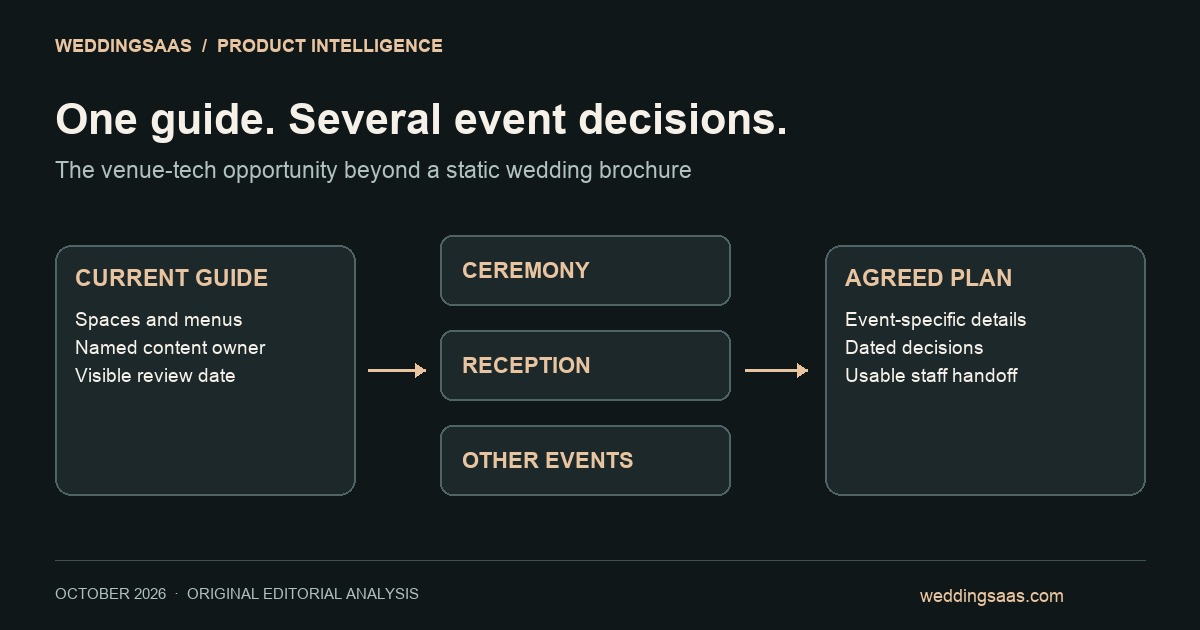
Our thesis is straightforward. A venue guide becomes more valuable when it helps a couple understand the next decision and lets staff maintain the information once. The opportunity is not merely replacing the PDF format. It is reducing the work caused by stale or scattered details.
What the product sources say
Tambourine’s current Hyatt product FAQ describes browser-accessible guides and multilingual content. It presents the wedding guide as a resource for spaces, wedding menus, experiences before and after the main event, imagery and preferred vendors, including cultural wedding templates. These are supplier descriptions; we have not tested a property deployment or measured its effect on bookings. 2
The distinction matters. A shared digital resource can be useful without proving shorter sales cycles. Nor does a public announcement establish which specific hotel has finished adopting a tool. Couples and planners should ask the property for its current guide and confirm the offerings relevant to their event.
A live guide needs a clear owner
For any venue considering a similar system, begin with ownership. Who updates the food and beverage information? Who checks capacity descriptions? Who confirms which spaces and services apply to a particular date? A single link is only as reliable as the process behind it.
Create a small publishing checklist. Record the responsible person, the last review date and whether the content is general information or part of a specific proposal. Give sales staff a way to flag an outdated entry. These are operational suggestions, not features we have verified in Hyatt’s product.
A useful trial task is to change one sample menu item and inspect the result on desktop and mobile. Then check how a colleague recognises that something changed. Count the places that still need a manual edit. The purpose is to find out whether the new tool actually reduces duplicate maintenance.
Multi-event weddings expose the limits of one brochure
Consider a hypothetical celebration with a welcome meal, ceremony, reception and farewell brunch. Each event may use a different space, attendance count, menu and supplier arrival time. A beautiful overview can still leave the operational questions unresolved.
Evaluate the guide against those separate decisions. Can the reader understand what belongs to which event? Can the team distinguish a suggested option from a selected one? Are access arrangements and practical constraints easy to discuss? Cultural planning should be shaped with the people involved rather than treated as a fixed checklist attached to a label.
This is a product-design opportunity for wedding software: keep the broad story attractive while making individual decisions clear. Test with an actual planning scenario, not just the prettiest page in a demo.
Current information and an agreed record serve different jobs
A living guide should be easy to update, but the event team also needs to know what the couple reviewed and agreed to. Our recommendation is to maintain a dated, approved event record alongside general reference content. Confirm how your selected software distinguishes the two.
For example, if an offering changes after a proposal was discussed, the team should not have to reconstruct the previous version from memory. Ask how versions, exports and approval notes are handled. This is an information-management question; it does not replace the venue’s contractual process or professional advice.
Also test a practical fallback: can authorised staff access the necessary event brief when reception is poor or a platform is unavailable? A convenient online guide and a usable day-of-event reference can complement each other.
The market angle: sell fewer repeated questions
Our analysis is that the clearest commercial pitch for this category is a measurable reduction in repeated work. Track how often staff resend materials, answer the same clarification or reconcile conflicting versions. Compare those tasks before and after a limited rollout.
For smaller venues, a controlled information workflow may be a better first investment than a broad feature bundle. For software builders, the opportunity is to connect current information, specific event decisions and an understandable handoff. No market-size forecast is necessary to demonstrate that problem.
For context on the wider software landscape, see AI Wedding Technology Landscape 2026 — The Complete Market Map. This article’s recommendation is to evaluate the work that needs doing before choosing the interface used to do it.
Reporting note
This is an October 6, 2026 analysis of an April launch and current product documentation, not an announcement of a new October release. WeddingSaaS has not independently tested Hyatt’s implementation. WeddingSaaS is published by Weddings.io Technologies, which operates in the wedding technology sector.
References
- Tambourine, April 27, 2026. Hyatt Wedding Guide launch release. Hyatt Wedding Guide announcement
- Tambourine Hyatt Event Products FAQ. Features and guide scope checked October 6, 2026. Hyatt Event Products FAQ