A couple can spend a fortune on a wedding and still have no intention of paying for your app. For investors and financial advisers, that is the first distinction to make: expenditure in an industry is not the same as revenue available to a software supplier.
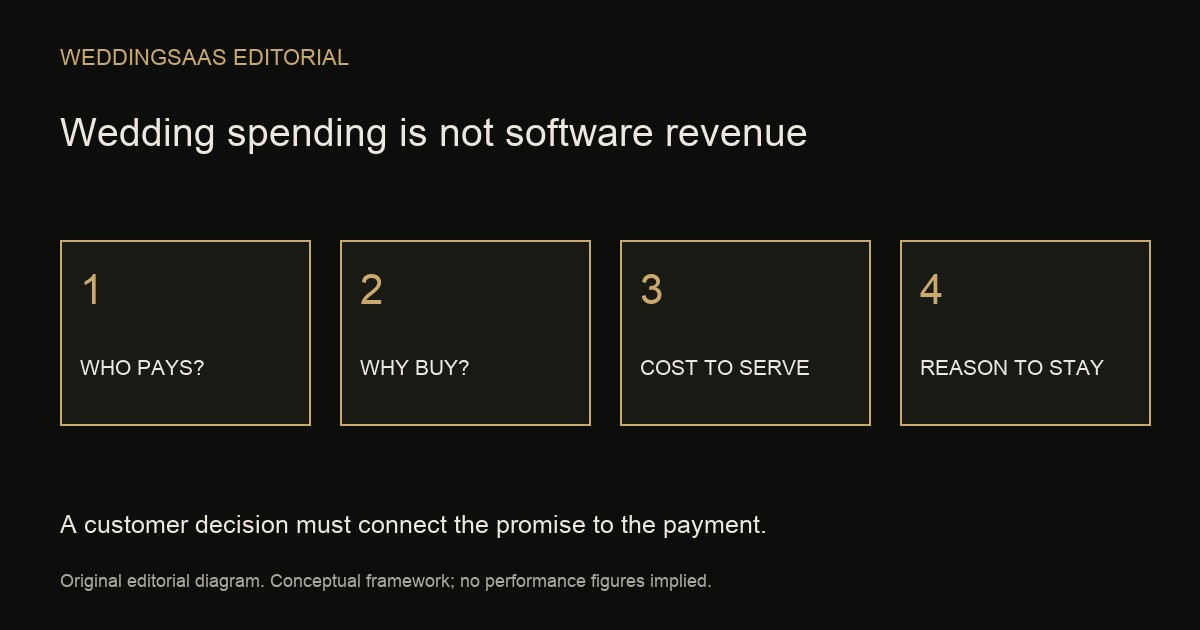
A wedding technology pitch often begins with total wedding spending, moves to planning complexity, and ends with an all-in-one platform. The missing bridge is commercial. Who pays? Which existing budget funds the payment? What result makes the purchase rational? How much contribution remains after acquiring and serving the customer?
Underwrite the revenue pool, not the wedding budget
A useful market model starts with an identifiable paying population. For professional subscriptions, build from eligible businesses, realistic adoption and annual revenue per paying account. For transactions, separate relevant booking volume, the share actually routed through the platform, and the fee retained. For a consumer product, estimate paying couples and revenue earned during their finite planning relationship. Keep overlapping revenue pools separate to avoid counting the same spending twice.
A historical disclosure illustrates the distinction. XO Group’s 2017 Form 10-K, covering The Knot’s then-parent company, described local and national advertising, transactions, and publishing as separate revenue streams. Its transaction business earned fees or commissions; it did not treat the full cost of customers’ weddings as its revenue. This is a historical business-model example, not a statement of The Knot Worldwide’s current finances. 1
Wedding expenditure can establish context. It cannot establish a startup’s obtainable market, pricing power or conversion rate. Those require evidence tied to a specific buyer and offer.
Separate four businesses before combining the product
Consumer planning software has a finite customer relationship. Completing the wedding can be a successful outcome and the natural end of usage. The acquisition case therefore rests on contribution earned during that relationship, rather than an assumption of indefinite subscription renewal.
Professional SaaS has a different test: repeated usefulness across events and enough recurring value to support renewal. Vendor advertising depends on the quality and economics of opportunities delivered. A transaction marketplace depends on completed activity and the economics of facilitating it. A platform can contain all four, but an investor should request separate revenue, service-cost and cohort reporting for each.
Likewise, distinguish customer money moving through a platform from the platform’s revenue and cash available to fund operations. Booking deposits, refunds and settlement obligations are not interchangeable with earned fees. The appropriate accounting treatment depends on the contracts and role of the business; a headline booking-value figure alone does not answer the revenue question.
Measure acquisition against gross profit and customer duration
Bessemer’s cloud metrics guidance treats customer acquisition payback as a gross-margin-adjusted measure. The relevant question is how long a customer’s gross profit takes to recover acquisition spending, not simply when cumulative revenue exceeds that spending. 2
For a recurring subscription, a transparent starting calculation is acquisition cost per new paying account divided by monthly gross profit per account (monthly revenue per account × gross margin). State the time period, included acquisition expenses and revenue assumptions. Where revenue or service costs vary materially, use the actual cohort’s cumulative gross profit rather than relying on a constant monthly average.
For illustration only: a $120 acquisition cost, $20 monthly revenue and 75% gross margin imply $15 monthly gross profit and eight months of payback. If the customer’s paid relationship lasts six months, that simplified model recovers only $90 before operating overhead. These are hypothetical inputs, not WeddingSaaS or Weddings.io operating results or an industry benchmark.
Show fully loaded and paid-channel acquisition costs separately, with clear definitions. Founder relationships and unpaid distribution can help establish demand, but a financial model should explain which channels remain reproducible when their volume increases.
Retention must reveal what the cohort actually does
Bessemer’s cloud framework identifies retention, gross margin, acquisition payback and cash consumption as important measures of a recurring-revenue business. Those measures provide a useful diligence vocabulary; they do not establish universal performance thresholds for every wedding business. 3
For paying professionals, show both retained accounts and retained revenue. Report gross revenue retention before expansion and net revenue retention including expansion, so increased spending by a few customers does not obscure lost accounts. Use consistent cohort definitions, disclose the calculation, and compare equivalent seasonal periods.
For couples, an expected end to planning should be distinguished from dissatisfaction. Measure completion, revenue earned during the relationship, support burden and referrals that actually produce customers. A conventional perpetual-retention assumption can misrepresent an event-bound product.
For vendors buying leads or advertising, connect enquiries to qualification, consultations, bookings and renewals. A rising lead count is not sufficient if availability, service area or budget makes those leads unusable. Where booking outcomes cannot be verified, disclose that measurement gap.
A feature earns financial value when it changes behaviour
A dashboard can attract compliments without changing a purchase decision. The evidence improves when customers pay, introduce colleagues, run additional events through the product or renew because it supports work they depend on.
Ask what would happen if the product disappeared. Would the customer lose useful demand, spend more time coordinating work, or face a material interruption? Then verify that answer through observed behaviour. Product breadth, AI labels and positive feedback are not substitutes for willingness to pay.
Capital should have a defined learning or expansion purpose
An early-stage investment can legitimately finance uncertainty. The pitch becomes stronger when it identifies that uncertainty and the milestone the money will establish: repeatable acquisition, reliable conversion, a lower service burden, or professional retention across a full seasonal cycle.
Separate a demand-discovery budget from a plan to expand a sales motion already supported by evidence. Present downside assumptions for conversion, customer duration, gross margin and acquisition cost, alongside cash runway and the point at which further funding would be needed. Do not imply that a larger wedding market resolves a weak unit-economic model.
The investment question
The wedding industry offers many problems worth solving. The financial case for a particular company still has to connect an identifiable buyer to a repeatable reason to pay, an economical way to reach that buyer, and sufficient value left after delivery.
The next wedding SaaS announcement worth underwriting should answer one question clearly: why will this company earn a place in someone’s budget—and what evidence suggests it can keep earning that place after launch attention disappears?
Editorial scope: this is a framework for evaluating business models, not a valuation of a named company. The linked sources support the historical example and metric definitions; the application to wedding software and the numerical illustration are WeddingSaaS Editorial analysis.
References
- XO Group Inc., 2017 Form 10-K, Item 1: Business. Historical disclosure of advertising and transaction revenue models; not current The Knot Worldwide financial data. SEC filing — XO Group 2017 Form 10-K
- Bessemer Venture Partners, The five accounting metrics for cloud companies. Acquisition payback measured against gross-margin-adjusted recurring revenue; methodology rather than wedding-sector benchmarks. Bessemer — cloud accounting metrics
- Bessemer Venture Partners, Roadmap: 10 laws of cloud. Framework covering retention, gross margin, acquisition efficiency and cash consumption. Bessemer — 10 laws of cloud
- Companion founder perspective: applying the commercial question to Weddings.io’s own direction. Weddings.io — earning our place in the budget